
Thể loại
Blog mới
Is It Necessary to Buy an SMT Splicing Machine? Starting from the "Experience Dilemma" of Manual Splicing
Oct 15, 2026In the daily operation of an SMT production line, splicing is a high-frequency operation that leaves no room for error. When a reel is about to run out, the operator must complete the joining of the old and new carrier tapes while the pick-and-place machine remains running, ensuring that material feeding is not interrupted.
The operation itself is not complex, but it has one core characteristic: quality is highly dependent on the operator's experience and condition.
If the line's reel change frequency is low and personnel are relatively stable, manual splicing can indeed be "good enough." However, when a production line moves toward a high-mix, low-volume model and reel change frequency rises significantly, the risks brought by "experience dependency" become amplified.
Personnel turnover brings more than just the issue of new employees' proficiency. Research in the SMT industry indicates that job satisfaction among operators has yet to reach an ideal level, and the impact of personnel turnover on standardized operations is a challenge commonly faced by manufacturing departments. When operations are not performed in accordance with work standards and rely excessively on "individual experience," production risks continue to accumulate.
Let us be clear: an automatic splicing machine is not a "must-have" in every scenario. For production lines with extremely low reel change frequency and a single, stable product model, manual splicing remains a reasonable choice. However, in scenarios with high reel change frequency, high personnel turnover, clear error-proofing requirements, and high demands for line continuity, the value of a splicing machine becomes indispensable!
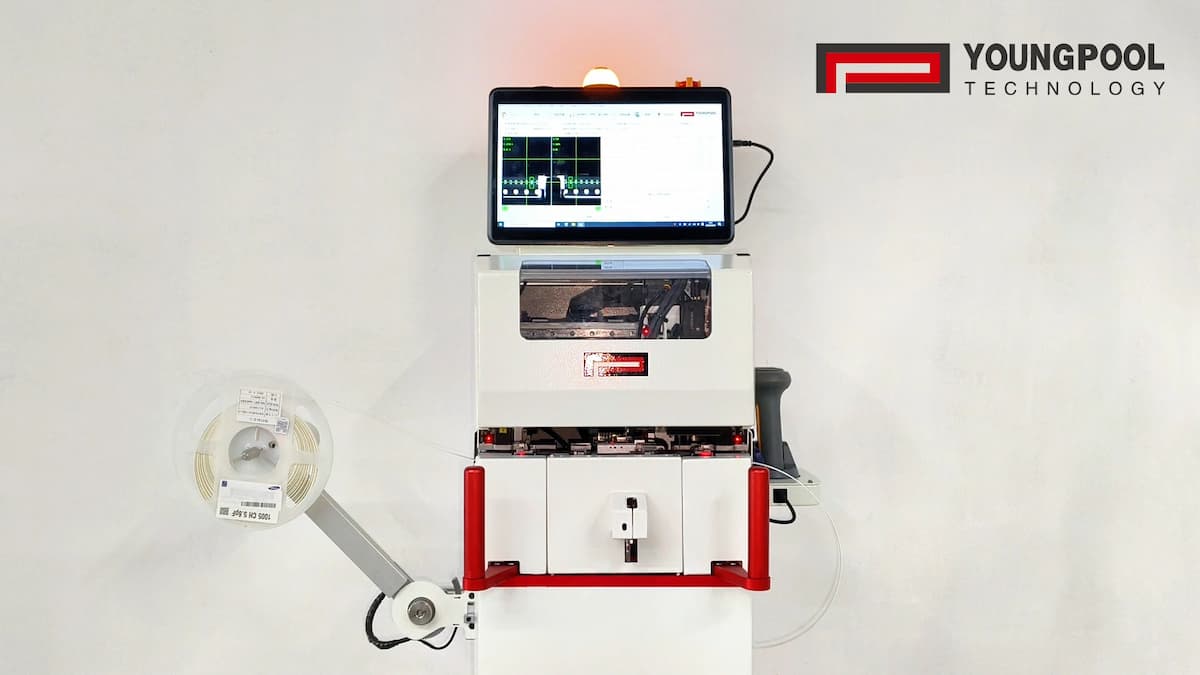
The design philosophy behind Youngpool Technology's L-900 Intelligent Splicing Machine is to transform the splicing operation from "relying on individual experience" to "standardized equipment output." The machine adopts a CCD vision positioning system, achieving a splice point gap precision of ±0.1 mm and an on-machine pass-through rate of over 98%. It effectively reduces alarms triggered by splice point issues on pick-and-place machines, boosting machine throughput by more than 10%.
In terms of error-proofing configurations, the L-900 offers five optional configurations: barcode comparison, LCR measurement, large/small component comparison, pitch recognition, and silkscreen comparison. Customers can select according to their own product characteristics and control requirements. Among these, the LCR measurement system can verify component parameters, further reducing the risk of wrong material. In terms of data capability, the L-900 supports MES integration, making the splicing process a collectable and traceable node on the production line's data chain.
The answer to "Is it necessary to buy an SMT splicing machine?" depends on the actual requirements of the production line for splicing consistency and error-proofing reliability. If you are evaluating the configuration plan for the splicing process, we welcome you to reach out and discuss with us.


 Mạng IPv6 được hỗ trợ